Saturday, January 1, 2011

Is The Wonderful Is This Life

By I. Rabschinsky


George Bailey Guy Making The Panik

So always in the America there is at this time the fooding, and also the Sports Produkt on the television. Many people filling themselves with Holiday as if they about to be told, "Next year, you cannot eat!". I am thinking they are the hostage of their Hindbrain, which is still Neanderthal and wishes to fight with Mastodon. But, still.

And, I am noticing specific films which is only appearing on Amerikanyets television at these months between like maybe September and the time of your New Year.

My examples: At Passover, some of the television is showing The Ten Super Big Mitzvah Rules, with Charlton Heston Guy -- you know, movie where Moses stop making fooling around to pretend he is Big Guy of the Egypt, and decides to get real job saving People Of Israel.

This requires lots of people walking around, always saying "Oh, Moses, Moses, Moses" -- like, if they say this three times, they will be teleported by magik into better movie. Navarone Kind Of Big Guns, maybe, or Socialist-Colored Panther.


Place Which Is Gone Forever: Amerikanyets Driving To Movies:
"Moses, Moses, Moses -- What is happening with our Drive-Ins?"

At another time in year, they are showing same Heston Guy what is Moses in Big Mitzvah Rules in another movie, Ben Of Her. However this is basically film of Jewish guy who becomes like early Jesus guy, but by accident.

Movie is good; he is Number Forty-One guy in slave ship, rowing like animator for the Disney; there are becoming big boat battle, and he gets to be some kind of honorary Goyim. Later, there is an exciting thing with horses and carts -- but it is not the porn film, so too bad for you. Go to web sites where they have not blocked you.


Charlton Ben Heston Making The Ramming Speed, 1959

At finally, with the Christmas, every year since somebody discover the Secret Of Fire there is this broadcasting this movie, It Is Wonderful This Life, made by Frank Capra Guy in 1947, showing the kind of place which everybody wanted to believe was the Amerika. Small town, everybody knows everybody; values is good and everybody work hard and knows their places.

Just like village in the Moldova, except animals do not leave defecation in the street, everyone is speaking English, and most people have job. Plus concrete used in apartment buildings is better quality.

Every single year they are showing this film. It is now a classic also, like Wizard Of Odd and Potemkin Kind Of Battleship and Mister Hulot Goes To Beach Place. It is as big movie as The Tanks Know The Truth (Very popular Great Patriotic War movie made in the Russia. My Great-Uncle Yehudi claims he is in this film as Extra, but still we love him).


Big Scene From Tanks Knowing The Truth: Are They Knowing?
Well, They Are Tank; You Are Person. You Want To Be That Sure?

It Is Wonderful This Life story is maybe simple: Guy, George Bailey Guy, living in small town wants to die, because he thinks his life is shit. And there are the angels, who show us life of this Guy in the little town, and how he is The Good, and there is the Rich Guy who is The Bad. And George Bailey Guy never gets to do things in the Life because the Fate is not for him.

Then there is mistake with money (a problem made from the Rich Bad Guy), for which he is blamed, and he runs from family and goes to place of Publik Alkohol; finally he goes to bridge to jump in freezing water so his family will get small piece of Insurance money. Very Sad (There is also squirrel in another scene which is sad, but never mind). Also very Petit-Bourgeois.

So, Angel Guy comes to the Earth and shows this George Bailey Guy his life is maybe kind of okay, not so much the shit; and boom boom boom, problem with the money goes away in big scene at end when everyone gives him their money, and everyone sings. So happy, little bells on tree and big bells of church ring; America wins the World War Two and future is filled with television and freeway. The End.

But this is too simple, my friend. No way is actual life like this. So, maybe some of me thinks this is kind of the Propaganda about America, to keep us from seeing the Truth of the Things.

And, there is forbidden version of this film, which is other kind of the Propaganda. Please -- allow me to introduce.


борьбе за построение социализма во время Угнетение
(также называется "Любовь и революция" после 1991)

("Love And Revolution", Directed By Frank Kapronovich [1949]; Starring Pytor Chost, Gravnik Bolodorin, Irina Valutin. Special appearances by the Spirit Of Revolution, also Che Guevara, Samuel Beckett, and entire 12th Guards Motorized Infantry Regiment)

SO, movie opens with Guy, Georgi Edwardovich Bailey Guy, at the Bridge. He is unhappy, this Guy; boy oh boy he is like making the panic. He goes to public alkohol place and tries to think, but he only finds himself between the forces of dissent and confusion!


TROTSKYITE GUY: River not so bad, after five minutes.
EXISTENTIAL GUY: Wait, but no one comes. No one cares.

Hoo boy; Georgi is in big fix. This guy has family with SmallChilds, and tiny Policy Insuring The Life -- and he is believing everybody would be better off if he would jump and get it over with, already.


GEORGI: My life is steaming pile of animal things,
because the Rich Guy will always win. Now I am jumping.

But, Georgi is being watched at Bridge. Not by some angel Guy (none of this reliance on things which cannot be proven by good Socialist science!) -- but even better -- is Spirit Of Revolutsya!


(Spirit Of The Revolution Watches Georgi)

And, The Spirit saves Georgi! He takes him to place where they can speak of things, of the Truth -- and slowly, Georgi's eyes are opened to not only the forces of historical determinism, but the inevitability of struggle against the oppressor classes!


GEORGI: So you are saying that when the consciousness
of the People is raised sufficiently, that armed struggle
is not only necessary but inevitable?
SPIRIT: You got it, Comrade.

So, Georgi, now with eyes opened thanks to the words of the kindly Spirit, is seeing that the world is filled with inequality and criminal things so big your head feels like kicked soccer ball. It is like understanding that, not only are you living as Dog, lapping up the vomit of the Rich Guy, but you work in factory to make guns to force others to live like this (Also, the Rich Guy pays you in fake dog vomit and those X-Ray glasses which do not work).

For Georgi, this is whole bunch of dried fish to eat in one night (Like story by that Guy, Dickens Guy, Carol Burnett Christmas, or something). This is the Life? He is asking himself.


A World Of Things For Them, But Not Food For Children


Economy And Bad Fate For Peoples Means Nothing To Them


For Them, The World Is Something To Carve Up, Like Beef


While The Many People Lose Everything To The Illegal Foreclosure

So now Georgi is filled with indignant and bad feeling for The State Of These Things. He feels the pain of the oppressed, working masses, and is being filled with Revolutionary Fervor -- and he goes to talk with the People in his little village, to tell them what the Spirit had revealed to him -- and the Spirit sends along friend, Che Guevara Guy, to help.


GEORGI: We don't have to live under the heel of Potter's boot!
He's just some, bloodsucking animal! Feeding on all of us -- and I'm
tired of living on fake dog vomit! We have to run things!
CHE GUEVARA SPIRIT GUY: Ay, Yi Yi! You listen to this guy.

The People, moved by Georgi's words, march with him to the place of the Bad Rich Guy, to demand Justice, the chance to make something other than guns, and to be paid in actual money instead of rubber dog vomit and X-Ray glasses which do not work.


BAD RICH GUY: You realize that the manufacture and sale of
weapons around the globe is the backbone of our nation's industry?
GEORGI: You don't understand -- the days of taking your rubber
dog barf are over, Potter! We're going to run things!
MOB: No fake dog barf!! No fake dog barf!!


BAD RICH GUY: My family has run this town for fifty generations.
All I have to do is close the factories. How long will it be before
your little rag-tag mob starts to starve? They'll come crawling back
to work -- and for half the rubber dog barf I gave you before!

Then, Georgi takes the Big Step -- the one which all oppressed people are taking in these movies when faced with Oppressors who pay them with rubber dog vomit: He crosses line from intellectualizing his oppression to active revolutionary.

Otherwise, we would have no resolution of all this rising action; and only ending for this film possible is that everyone would go for Pizza. This is unsatisfying from view of the Socialist imperative.


GEORGI: You're wrong, Potter -- you, and people of your
class are finished. Now you're going to face Justice for your
crimes -- because the People own the means of production!

And so The Bad Rich Guy is taken away by the People; his house later becomes hospital, day-care center, and place where revolutionary theater troupes practice before going into the streets.


And, of course, there is a proper celebration at the Georgi Bailey house, with the Revolutsia Spirit and the SmallChilds.


GEORGI: Gosh, Spirit, I don't know how we can thank you.
SMALLCHILD 01: Spirit, can't you stay and have some Fair
Trade™ coffee with homemade whiskey with us?
SPIRIT: No, SmallChild; I must go. There are so many oppressed
peoples in a world beset by unspeakable monsters of Capital.
But I will take a shot of that whiskey -- neat, please.

Finally, after long discussion between Rich Bad Guy and the Organs Of State Security, he faces Revolutionary Justice and the verdict of The People.


RICH BAD GUY: Long live International Capitalism!
PEOPLE'S MILITIA LEADER: Fire!

And, of course, Georgi and his lovely wife are pausing in their labor to build a New Socialist Future to share a moment's reflection on the plight of The Peoples, and also to suggest some hygienic sexual activity between them which may occur later.


...and in the background, The Internationale swells on the soundtrack, sung by the Sad Vlad Orphans Choir Of Greater Moscow! Please to show the credits!

This film has not been shown since its original release; big shame, also, because it is at least as good as movie with Bert Landcaster in it but of the name, just now, is escaping me.

Great-Uncle Yehudi likes Revolutionary Love. He thinks it is wonderful comedy, but still we love him. If you can find this film on DVD, then okay. If not, well then it is big world out there! Be That Guy -- go find!

I, Rabschinsky, say this -- to Moldavish Guy; you also.


Friday, December 31, 2010

Something Something Something Alud; Something Something Be Forgot

Happy 2011


Times Square In New York City, With It's Famous Ball

What does this song mean? My whole life, I don't know what this song means. I mean, 'Should old acquaintance be forgot'? Does that mean that we should forget old acquaintances, or does it mean if we happened to forget them, we should remember them -- which is not possible, because we already forgot?
-- Harry Burns [Billy Crystal], "When Harry Met Sally" (1989)

To friend and foe, from one older and rather beaten up Dog in 2010, to all of you: A Happy (and, Better) New Year.


Thursday, December 23, 2010

What The Dog Is Doing: Holiday Edition 2

The Dog Biscuit: A Trip, And More Art

San Francisco has a decent set of arts museums -- The M. H. de Young Memorial Museum and the Palace of the Legion of Honor (collectively known as the Fine Arts Museums of San Francisco (FAMSF)), in addition to the Museum of Modern Art (SFMOMA), and the Asian Art Museum.

The de Young is in the center of Golden Gate Park, the Legion of Honor in the Presidio on the Pacific coast. Both house the City's collections of European and American art from the Medieval through, roughly, the end of the Second World War (though the de Young does have wings dedicated to collections of both Pacific, African and Meso-American art and artifacts).

I sleep later on weekends or vacations; Dogs do that. Getting up this morning, I just wanted to be in motion, not thinking a great deal (because I've been doing that too much lately, and it's done me little good), and decided to get out the door as fast as I could and take a two-bus trip to the de Young: Shower, shave, dress; kultur.

There's a traveling exhibition from Paris' Musee d'Orsay, "Beyond Impressionism", which I haven't yet seen, and won't until later in January, before it leaves (When I was there today, every timed tour group for the show was sold out, all day). All I wanted was to wander a little and see my favorites in the museum's general collection, hoping that looking at these images would be beneficial, centering, inspiring.


The Exposition And The Entrepeneur

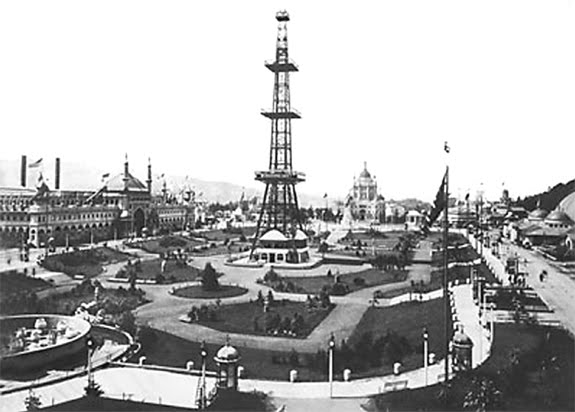
In January of 1894, San Francisco had hosted a 'Midwinter International Exposition'. Michael H. de Young, editor and sole proprietor of the San Francisco Chronicle, was the chief proponent and organizer of the Midwinter fair; two years earlier, de Young had been part of the commission to decide on a location for what became the 1892 Chicago World Columbian Exposition, and wanted to create a similar draw for arts and culture (and money to the local economy) in San Francisco.


Midwinter International Exposition, 1894 (Photo: Wikipedia)

[For those familiar with Golden Gate Park, the current site of the de Young museum is on the left, the Academy of Sciences on the right. From the racetrack-style concourse and sunken central gardens, it's easy to see where this part of Golden Gate Park had its genesis.]

An Egyptian-style fine arts hall built for the Exposition (and a large Japanese garden) remained after it closed. Fourteen years later, after being damaged in the 1906 earthquake, the fine arts hall was repaired. In 1929, it was pulled down and replaced by a Spanish Renaissance structure -- which in turn was damaged by the 1989 Loma Prieta earthquake, demolished, and replaced again by a new museum in 2005.


The De Young Museum As It Appeared From 1929 - 2001
(Photo: Lost SF [Blog By A Native About A Changing City])

The night of the Loma Prieta Earthquake in October of 1989, I accepted a ride from the San Mateo train station into The City -- the driver cut across Golden Gate Park at 9th Avenue, and the museum with its distinctive tower was clear in the moonlight. The entire city was without electricity, and I wondered about the building's alarms and whether any of the art had been damaged.

The de Young I saw in a Prussian blue and silver-grey outline that night was the museum that I'd effectively grown up with. Many of my memories of San Francisco, until I moved here, have Golden Gate Park and at least the outline this particular building as part of them. After that earthquake, the art was fine -- but in the photo above you can see the support bracing that visually announced the building's death sentence: It would have to be replaced.


Bequests, Building, And Public Beneficiaries


Aerial View Of The New de Young, Completed 2005

The history of building any large museum can't be separated from its evolution as an organization, though that's more complicated (it involves the relationship between governments, and established wealth as the traditional support for public culture, and the benefits to established wealth for doing so), and would take more space than it deserves here.

The short version is, after Michael H. de Young died in 1925, his family made a bequest of much of his private art collection to the City and County of San Francisco -- and the City's part of the bargain in accepting that bequest was to demolish the old fine arts hall left from the exposition de Young had helped create, replacing it with a new, Spanish-influenced building to display the man's collection for the public.

The de Young Museum remained a separate institution for over forty years, until the Fine Arts Museums of San Francisco (FAMSF) was established in 1972, with a charter to reorganize and reinvigorate San Francisco's public art collections. FAMSF redistributed the bulk of what had been de Young's European art to the Palace of the Legion of Honor, but keeping the Pacific and Meso-American collections at the de Young -- and, an impressive, predominantly Chinese collection of Asian art (a bequest from Avery Brundage, later moved to its own museum after 2001).

What the de Young had always offered the public was a good collection of art, the largest and best in California; excellent for a regional institution, but not competitive with those of museums in New York, Washington D.C., Paris, Tokyo, London, or Berlin. However, when John D. Rockefeller III died (1978), and later his wife, Blanchette Hooker Rockefeller (1992), the tax advantages from bequesting portions of their large private art collections meant that some 100-plus paintings came to the de Young, and began to move its collection into world-class territory.

When it was clear the 1929 museum could not be retrofitted or repaired from damage in the 1989 earthquake, that de Young was demolished, and reincarnated in a museum that reflected changes in public architecture, and the times -- America's economy was at the height of the Go-Go, "Lil' Boots" Bush era.


The de Young Museum And Observation Tower (North View)

In 2005, the year the new de Young opened, our Bubble-fed economy had drifted as high as it would go. Public structures reflect something of the Zeitgeist of the times in which they're designed and built, and I wonder whether something of the baseless extravagance and exuberance of those times made it into the new de Young's architecture.

Losing the old de Young was (as it is for anyone who anchors memory and self to places and things) more than a disappointment; a sad little reminder of aging, and how the City where I've spent over half my life is changing. I try to see the new de Young as a bold statement, and with fresh eyes; but, frankly, I'm not there to see the outside of the building. The interior is what counts, and it's a well-designed set of spaces to view art, and display the painting collections very well.

So, let's go in; we'll walk around a little (don't worry; it's not some Sister Wendy / Simon Schama exercise; I'm not going to tell you what the paintings "mean") and we can stop to look at what (in one Dog's opinion) are a few beautiful and even exceptional works.


The Permanent Collection: A Select Look
All Images By Mongo / Photoshop

In the first gallery on the ground floor are the parts of the permanent collection that embrace primarily American painting from before the Great War, to the Sixties and beyond. This strays into the territory of the SFMOMA a bit, but no one minds.


Georgia O'Keeffe, Petunias (1925), Oil On Panel

O'Keeffe (1887 - 1986) had begun creating images of flowers, which remain one of her iconic trademarks, in 1924. She had just sold a similarly-sized work of lilies through the gallery, 291, owned by her husband, photographer Alfred Stiglitz, for $25,000 (nearly a quarter-million dollars today). She and Stiglitz had married in 1924, living and working in New York City and summering at the Stiglitz clan's upstate Lake George home. O'Keeffe wouldn't go to Taos for the first time until the late spring of 1929.

O'Keeffe was a meticulous painter, and depended on as smooth a transition as possible in blending values between hues of paint (you can see this in the purple - violet - red/violet hues in this work). And, finding the general frames of the period too ornate and distracting from the art, she frequently made her own, covering them with gesso and applying silver leaf. The frame on Petunias is one of her own.


Grant Wood, Dinner For Threshers (1934), Oil On Panel
(Click On Image For Larger Version)

Grant Wood spent only a short time in Europe in the early 1920's, but the effect of seeing the work of Northern German artists of the late 16th and early 17th centuries became the basis for his mature artistic style. Compare his most famous, iconic American painting, American Gothic, with the portraits of Holbein and Dürer and you'll see the connections.

The same year Dinner For Threshers was completed, Wood's work was featured in Time magazine in an article titled “The U.S. Scene”, and featured his art, along with fellow Midwesterners John Steuart Curry and Thomas Benton -- portraying the three men as the new heroes of an 'authentic American art'. The media began calling them founders of 'Regionalism' as a significant art movement -- while the art community in New York referred to them derisively as the "Prairie School".


Thomas Hart Benton, Susanna and the Elders (1938),
Oil and Egg Tempera On Panel

In the Pentateuch, Book of Daniel, a virtuous wife named Susanna bathes alone in her garden, watched by two lustful elders. They threaten to claim she was meeting a young man, unless she agrees to have sex with them. She refuses, and as she is about to be put to death for promiscuity, the young Daniel interrupts and demands the accusing elders be questioned, separately. Their stories don't match; Susanna is freed, the false accusers are put to death, and virtue triumphs.

Thomas Hart Benton (1889 - 1975) was the artists who made the cover of the December 24, 1934 issue of Time magazine, featuring Benton, Grant Wood and John Curry in “The U.S. Scene” article that established Regionalism as a recognized art movement.

Benton was born in Missouri; his father was a U.S. Congressman and uncle a U.S. Senator. Groomed for a political career, Benton rebelled -- he studied art in New York, and actually lived in the East most of his life. However, he was more politically conservative than his artistic contemporaries; when the Great Depression hit, Benton returned to the midwest, finding work through the WPA as a muralist, and continued developing his style in works with a regional theme, like Susanna and the Elders.

The work created a stir in 1938 when it was first displayed; even a retalling of a Biblical story, featuring a nude with clearly depicted pubic hair, was a little over the top for the folks in Kansas City.


Let's walk up the broad staircase to the second floor, where the bulk of the American collection is located. The Pacific and African collections are on this floor, too, but that's for another visit.


The Sargents


John Singer Sargent, Study Of Florentine Architecture (18XX)
Oil On Canvas

John Singer Sargent (1854 - 1925) was a rara avis of the art world: A person who seems born to do their art with near-perfection, right from the beginning, and as simply as breathing (in contemporary terms, painters like Bo Bartlett come to mind). It doesn't mean that Sargent never worked at his craft, but compared to the rest of us it's the difference between fine-tuning and real intense effort. The man had a genius.

Sargent (who was known as "John S. Sargent" during his life, and not his full name) was definitely a prodigy, and studied the en premiere coup (or, wet paint painted into wet paint) method under the French painter Carolus Duran in Paris. By design and virtuoso handling of paint, Sargent became within less than fifteen years one of the most sought-after portrait painters in the Western world.


Sargent, Portrait of Caroline de Bassano, Marquise d'Espeuilles
Oil On Canvas

Portraiture is one of the most difficult arenas of art: You have to produce not only a recognizable likeness of a person, but at the level at which Sargent was operating, a flatteringly recognizable one. He painted portraits of academics and scholars, other artists and friends -- but also the Old and Noveau monied grandees of the old World (principally England), and the New (the astoundingly rich American wealthy of the Gilded Era).

These were not people renowned for their patience, or egalitarianism, or in acting in an adult fashion when not getting exactly what they wanted, as they wanted it. Artists like Sargent were certainly valued, but no more than a designer or other employee they'd hire and pay a wage to produce a thing -- like a portrait.


Sargent, A Dinner Table At Night, (1884)
Oil On Canvas

Sargent knew his portraiture was something he could do for money -- I'd be an idiot not to make as much cash as I can, and he did: A full-length oil portrait by JSS at the height of his popularity in the mid-1890's could cost up to 1,000 Pounds in England ($4,880 1894 U.S. dollars, at an exchange rate of 1 Pound = 4.88 US -- and that Four Thousand-plus dollars is $126,000 in 2009 value. Get your own calculations here). Sargent produced scores of portraits; it was an age awash in wealth, and for a person with demonstrable artistic talent, he did very, very well.

But he knew he was a hired hand, and had a love-hate relationship both with painting his "paughtraits", as he referred to them, and in dealing with the overgrown children who demanded make me look beautiful when they weren't. That he wasn't focused (as Thomas Eakins was) to show the 'truth' of a client / sitter's personality allowed Sargent to make the plain, if not beautiful, then at least "not plain" -- part of a harmonious and bravura display of artistic technique.


Sargent, A Trout Stream In The Tyrol, (1914)
Oil On Canvas

At the outbreak of the Great War in August, 1914, Sargent and several friends were on a walking / painting tour of the Tyrolean mountains (the painting above was done then), and had no idea that the assassination of the heir to the Austro-Hungarian throne was going to turn into anything. Europe had been at peace so long; the idea of war seemed "silly".

In early August, Sargent found himself and his English travel;ling companions briefly interred by the local Hapsburg authorities. It took a few weeks for them to be released -- Sargent as an American neutral, and his English friends as harmless (things were handled a bit differently, in the Old Days). Sargent returned to his home in London, and painted. What else could he do?

In the spring of 1918, he was asked to serve as an official War Artist for the British government close to the front. After the Armistice, and the peace that followed in 1919, Sargent was given a commission as a recognized great artist by the British to paint a picture that epitomized the four years of struggle their nation had been through. He produced two -- Some General Officers Of The Great War, a large group portrait of the British Empire's victorious generals; but -- though his English hosts had hoped for something in the heroic tradition of art from previous wars -- in his second work, Sargeant instead gave posterity Gassed, a truer vision of war as he had experienced it.

He continued producing work until the week he died, in 1925.


Thomas Anschutz, The Ironworker's Noontime, (1880)
Oil On Canvas

Thomas P. Anschutz (1851 - 1912) studied art at the National Academy of Design in New York City, and moved to Philadelphia in 1875 to study under Thomas Eakins. He entered the Pennsylvania Academy of the Fine Arts in 1876 -- became Eakins's assistant in 1878, and (after Eakins resigned over disagreement with his teaching methods) his successor in 1886.

The Ironworker's Noontime is possibly my favorite painting in the de Young collection; it's the one I remember having an effect on my own art when I first saw it in the mid 1970's. Anschutz, as much a teller of truth in art as his mentor, Eakins, wanted to honestly depict the state of a group of ordinary American workers, and critical reaction at the time was almost uniformly negative.

Wikipedia notes: "One of the first American paintings to depict the bleakness of factory life, The Ironworkers' Noontime appears to be a clear indictment of industrialization. Its brutal candor startled critics, who saw it as unexpectedly confrontational -- a chilling industrial snapshot not the least picturesque or sublime."

In his time as director of the Pennsylvania Academy, Anshutz's students included Robert Henri, George Luks, William Glackens, John Sloan, Charles Demuth, John Marin, and Charles Sheeler, among others.


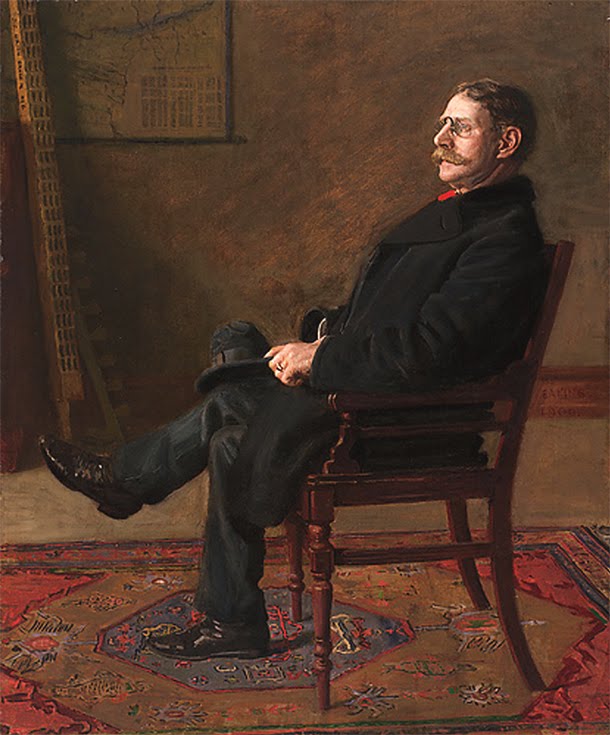
Thomas Eakins, Portrait Of Frank Ray St. John, (1900)
Oil On Canvas

On the same wall as Anschutz's Noontime is a portrait by his old mentor, Thomas Eakins (1844 - 1916).

Eakins was known in his lifetime primarily as a teacher of art, who painted. He sold few paintings during his lifetime, and his strict adherence to getting to the truth of a thing through his painting meant many wealthy Philidelphians who engaged him to paint their portraits ended up returning them to Eakins as unsatisfactory.

In 1886, as a director of the Pennsylvania Academy of the Fine Arts, Eakins was embroiled in a controversy over his use of male, and female, nude models for drawing classes, and some allied incidents. The parents of local students in Philidelphia were concerned that Eakins was a corrupting influence (artists being equated with libertines and radical thought is nothing new); the board of directors dismissed him. Eakins was deeply embittered by the act, and never really recovered from it.

It was another twenty years before Eakins' talent as an artist began to be recognized -- belatedly, and not in monetary terms -- and not until well after his death in 1916 that his work was seen as important contributions to American art.


UPDATE: This post is still under construction -- there will be additional works from the de Young added shortly.


Tuesday, December 21, 2010

What The Dog Is Doing: Holiday Edition


Travis Schlaht, Pierre de Ronsard, Oil On Canvas 12 X 14 (2007)

As a Dog capable of self-locomotion, I'm on vacation this week; post-Hanukkah, pre-Festivus, pre-Bill O'Reilly's Day. I haven't gone anywhere -- just relaxing and getting some actual work done as opposed to the Witless Labor™ I perform most of the rest of the year.

Today, I finally went downhill from where I live to the John Pence Gallery on Post Street in The City. While walking down the southern face of Nob Hill from the Mark Hopkins hotel, for a short time I kept passing members of the Bohemian Club, walking uphill from their Special Treehouse, most probably after lunch.

The Club's dining room is said to serve a decent repast, as you'd expect for one of the centers of power in the Western world. Can't have Our Lords eating like the Peasantry, can we?

The Bohemian Club was originally founded in 1872 in San Francisco by local journalists who wanted contact with the artists of The City -- writers, painters, actors; musicians and librettists. However, that changed quickly; as Wikipedia noted, Journalists were to be regular members; artists and musicians were to be honorary members. The group quickly relaxed its rules for membership to permit some people to join who had little artistic talent, but enjoyed the arts and had greater financial resources. Eventually, the original "bohemian" members were in the minority and the wealthy and powerful controlled the club.


Bohemian Club Building, San Francisco

And so it is today. The Bohemian is a publicly-known exclusive club for the wealthy, the powerful, the connected. The club's bylaws state that approximately a quarter of the membership are to be actual artists, but are only admitted after an audition or show of their work for the real members -- whose understanding of art is only that they can afford to purchase as much of it as they want. The artists are only for show; the real business of the club goes on with its 'real' membership.

A Who's Who of members attending the Club's annual 'Bohemian Grove' celebrations in Marin County would include most of the country's corporate elite, banking and financial organizations; old-money families; and politicians of both parties. Needless to say, over the two weekends each year when the Club hosts its revels, a lot of informal business is done and connections for future business created.

I passed the front of the Club, covered in dead ivy leaves, with its main members' entrance (which you might have seen in the film The Game, where Michael Douglas' investment banker character is [aber natürlich] a member, and meets his brother [Sean Penn] for lunch). A plaque around the corner on Taylor Street honors poet and writer Brett Harte -- who would probably vomit to see just where the accolade was placed, and the sort of characters hosting it. Not so strangely, the Bohemian's building is architecturally cheek-by-jowl with another, lesser San Francisco club, the Metropolitan.

Universally, the men I passed were white-haired Caucasians in their late fifties to mid-sixties, and very well-dressed: Camels'-hair overcoats over their houndstooth sports coats; shined, toe-cap Oxfords; and a bow-tie or two. That, and the demeanor of persons who take no one seriously outside their own class. They don't have to; they'll only engage you if they want their Jag tuned or their bathrooms cleaned, or you have something they want: Then you feel the not-necessarily discreet charm of the haute bourgeois, and you'd best know your place and snap to.

Finally, I made it to the gallery (with a side trip to a second, small display of student work at a branch of the Art Institute of San Francisco). John Pence, the gallery's owner, has been a major figure in the contemporary realist movement in American painting; a supporter of figurative, realist artists, like the two that have had shows this past month:


Steven J. Levin
All Images © The Artist; Information On The Painter


Self Portrait, 2005


The Cloud, 2010


Tangerines and Water Goblet, 2010


The Rembrandt Room, 2008


Dirt Road, 2010


Randall Sexton
All Images © The Artist; Information On The Painter


Dishrack #1, 2010


Cliff Shadow, 2010


The Cove, 2010


Nob Hill Stories, 2007


On my way back home, I stopped for a moment of quiet in Grace Cathedral, the reinforced-concrete faux Gothic church on Nob Hill, and a stone's throw from another Club for The Elite, the Pacific-Union. Inside, silence almost visibly hangs in the air, the sense of a living presence (which was the point of much sacred architecture from the Gothic era; the soaring, vaulted spaces lifting the eye heavenward). The place was, thankfully, almost empty.

In one of the front pews, I sat for a while, and finally recited to myself a variation on a few lines from one of my favorite John Cheever short stories, "The Apples Of Heaven", where an old poet afflicted with an emblematic sickness of spirit says a prayer made of the names of writers he admired.

God bless Edward Hopper, I thought; God bless Georgia O'Keeffe, and Arthur Dove, too (though I don't like most of his stuff); God bless Jean "Moebius" Giraud; God Bless Alex Ross; God bless Michael Whelan and Donato Giancola; God bless Maxfield Parrish; God bless Fortuno Matania; God bless Henri Matisse, and Vincent Van Gogh, and Claude Monet; God Bless George Grosz, and Käthe Kollwitz; God Bless Albert York; and God bless Mark Rothko; and particularly God bless John Singer Sargent.

What gets me out of bed in the mornings is not the Witless Labor I have to perform for money; it's for whatever small mercies my days may contain, and to see things of beauty -- and if I have the chance to make a few of my own, es ist Besser so.

Now I am home, on my rug by the heater, having turned around twice before lying down: Happy Secular and Non-Secular Holidays To All, and To All A Good Night.


Thursday, December 16, 2010

The Truth Is Out There


For Most, This Is The Signpost At The Border Of Consciousness

Yet, Strangely, No One Gives A Damn

I'm not in the habit of reposting other people's work in full.

That said, Barry Ritholtz, financial investment analyst and a person of consistently-demonstrated intelligence, operates his own very successful site, The Big Picture, and is the author of a get-to-the-meat-of-it book about the 2007-2008 Crash, "Bailout Nation".

I have issues with what Barry does for a living, and have written about that before; however, that doesn't stop me from frankly admiring his intelligence and insight.

And that being said, I want to repost in full something which he noted on his blog this morning. It isn't laziness on my part; when I see a distillation of information that can help clarify a situation most politicians and the Mainstream Media have only helped to obscure...

Well, read it; learn something -- even better, do your own research.


10 Questions for GOP Members of Financial Crisis Inquiry
By Barry Ritholtz - December 16th, 2010, 7:45AM

I never wanted to write Bailout Nation.

That only came about after Bear Stearns collapsed. McGraw Hill approached Bill Fleckenstein to do a follow up to his successful Greenspan’s Bubbles: The Age of Ignorance at the Federal Reserve, about the end of Bear.

Fleck turned them down, but the publisher asked him who else was covering this subject. I was told he said “That’s easy, Ritholtz has been all over this story.”

I turned McGraw Hill down — repeatedly. But they cajoled and flattered and eventually I relented. I approached the subject from a blank slate, pragmatically, with no agenda. It was a problem solving exercise, I began by looking for data that led me where it would. Following the money was good advice for anyone researching this.

That data led me to numerous conclusions: I blamed Republicans, I blamed Democrats, I blamed the Federal Reserve, Congress, the ratings agencies, mortgage originators and lending banks, the biggest Wall Street firms, the SEC, borrowers and home buyers, the RE agents, the mortgage brokers, appraisers, and Collateralized debt obligation (CDO) managers. I blamed Greenspan & Gramm, Bush & Clinton, Paulson & Bernanke & Rubin & Summers, Even mutual funds, compensation consultants and crony corporate board members come in for criticism. (This is only a partial list).

Which leads to today’s exercise in willful ignorance.

The 4 GOP members of the FCIC have a document which purports to have questions and answers on the causes of the financial crisis. It is a silly analysis that could have been written by wingnut think tanks like the AEI or Cato BEFORE the crisis even occurred. It absolves Wall Street and the banks, blames the government — for everything — and ignores reality and the data that conclusively demonstrate otherwise.

To these people, I ask the following questions:

1. From 2001 to 2003, Alan Greenspan took rates down to levels not seen in almost half a century, then kept them there for an unprecedentedly long period. What was the impact of ultra low interest rates on Housing, credit, the bond markets, and derivatives?

2. How significant were the Ratings Agencies (S&P, Moodys and Fitch) to the collapse? What did their AAA ratings on junk derivatives affect? What about their being paid directly by underwriters for these ratings?

3. The Commodities Futures Modernization Act of 2000 removed all Derivatives from all oversight, including reserve requirements, exchange listings, and disclosures. What effect did the CFMA have on firms such as AIG, Bear, Lehman, Citi, Bank of America?

4. Prior to 2004, Investment Houses were limited to 12-to-1 leverage by the SEC’s net capitalization rule. In 2004, the 5 largest investment banks asked for, and received, a full exemption from leverage restrictions (known as the Bear Stearns exemption) These five firms all jacked up their leverage. What impact did this increased leverage have on the crisis?

5. For seven decades, Glass Steagall separated FDIC insured depository banks from riskier investment houses. Prior to the repeal of Glass Steagall in 1998, the market had regular crashes that did not spill over into the real economy: 1966, 1970, 1974, and most telling of all, 1987. What impact did the repeal of Glass Steagall have on the banking system during the 2008-09 crash?

6. NonBank Lenders: Most of the sub-prime mortgages were made by unregulated non-bank lenders. They had a ”Lend to securitize” business model, and they sold enormous amounts of subprime loans to Wall Street for this purpose. Primarily located in California, they were also unregulated by both the Federal Reserve and the California State legislator. What was the impact of these firms?

7. These firms abdicated traditional lending standards. They pushed option arms, interest only loans, and negative amortization mortgages, all of which defaulted in huge numbers. Was non-bank, sub-prime lending a major factor in the crisis?

8. The entire world had a simultaneous global housing boom and bust. US legislation such as the CRA or Fannie & Freddie only covered US housing and lenders. How did this cause a worldwide boom and bust — even bigger than that in the US ?

9. Prior to the 2004, many States had Anti-Predatory Lending (APL) laws on their books (and lower defaults and foreclosure rates). In 2004, the Office of the Comptroller of the Currency (OCC) Federally Preempted state laws regulating mortgage credit and national banks. What was the impact of this OCC Federal Preemption ?

10. Corporate Structure: None of the Wall Street partnerships got into trouble, only the publicly traded iBanks. Partnerships have full personal liability for their losses. What was the impact of this lack of personal liability of senior management on Wall Street risk management?

I can go on and on — but the concept is rather simple: If you cannot answer these questions, or adequately explain these facts, then how on earth can you explain the credit crisis?

-- Barry Ritholtz


Wednesday, December 15, 2010

Salvato! Silvio Salvato Per Avere il sesso con più ragazze adolescenti!


Silvio! Acts Good, As A PM Should (Photo: The Age.au)

Stability

Prime Minister Silvio Berlusconi, Primo Pene l'Italia, has been given a serious wake-up call: A vote of 'No Confidence' in his government, which he barely survived.

[I have to admit at this juncture, as a Thinking Dog, I have to fight off a desire to explain what that, and differences between a Parliamentary system of government and the Rotating Clown College we use in America. From this point forward, if you're reading something and don't understand it, Tut mir leid. Please do your own research.]

He survived the vote in Italy's Upper Chamber of deputies by 3 votes. In the Lower Chamber of Italy's parliament, Berlusconi's National People's Fascisti Pizza Party has an approximate 25-vote majority -- but it was the vote Tuesday which, if successful, would have forced new Parliamentary elections and removed the tubby Oligarch Berlusconi from power.

In his defense, Berlusconi relied on the same argument which originally brought him to power: Italy, having gone through over 50 governments since 1948, "needs stability". In 2010, Silvio told the Deputies, with the world in an economic crisis, Italy needs continuity and stability, which only a 74-year-old hormonally-raging multi-billionaire with poor impulse control can provide.

Silvio!, as a multi-billionaire Oligarch who runs his own country, favors the 'New Austerity' measures which will force the populations of Europe to pay off debts incurred by corrupt banks (and billionaires), so that the Banksters won't lose a dime of their hard-earned loot.

I particularly liked the part in film from Italian television of Silvio! striding into the Upper Chamber, past the table with his government's ministers -- and noting how many of them were exceptionally beautiful women whom he has hired over the past few years. Their staffs, presumably, run the ministries -- because the appointed Ministers are former models and actresses.

One of these women Ministers (sadly, I do not know who) was interviewed by Agence France-Presse; she was asked point-blank if she found Silvio's! antics with, and demeaning comments toward, women as personally offensive to her. "The Prime Minister behaves like a typical Italian man," she replied. "And thank God he likes women."

And, the Italian people took it well: they demonstrated (some reports say rioted) in the streets.


Crowds Of Demonstrators Battle Italian Police (Video: UTube)


Public Reaction To Berlusconi's Continued Reign (Video: UTube)

I'd remind him of Romania, and what happened to little Nicky Chaucescu -- but I'm only a Dog, and no one listens to me.

Ha Ha Ha -- that Silvio!

Wednesday, December 8, 2010

New Normal


The New Normal (NYT, 12/08/10)

The 'deal' orchestrated by President Obama and his 'team' with the Rethugs is already being debated. Last night, Charlie Rose had four commentators in round-table discussion (more or less; only one was actually in the studio): U.S. Representatives Jan Schakowsky (D - Illinois) and Anthony Weiner (D - NY), Kenneth Rogoff (Thomas D. Cabot Professor of Public Policy, and Professor of Economics at Harvard University), and Al Hunt, the Managing Editor for Bloomberg News.

Rogoff and Hunt were the Center-Right guests; Schakowsky and Weiner (who is one of the Democrats' most articulate and energetic spokespersons) were Progressive-Left. While Rogoff pooh-poohed it all with a well-so-what? attitude, Schakowsky and Weiner were absolutely clear: This 'compromise' adds hundreds of billions of dollars to the National Debt in order to provide tax breaks for billionaires (That, nearly a direct quote from Weiner).

Hunt noted that his reporters tell him the Republicans were willing to make more compromises, if the President and his administration had made a harder fight -- and were amazed when they received everything they wanted, allowing them to give Obama only one real concession: Extension of unemployment benefits.

Hunt related that the Republicans had instructions to give ground on everything except provisions in the Bush Tax Cuts involving the Estate Tax (of most benefit to only the wealthiest Americans with extremely large personal fortunes) -- that they would give Obama everything except that.

Rogoff concluded that there were many provisions in the deal that assisted the working poor and families; Representative Weiner responded that this was important, and that compromise in Washington is expected -- but, he asked, where was the President we voted for? He didn't define the debate for the country, allowing the Rethugs to do that.

Weiner asked, "People expected that [Obama] was going to roll up his sleeves and fight for America's middle-class working families." Why didn't he do that? Why does he say now this deal was the "best" he and his team could do -- when that is so obviously not true?

In the end, Weiner added, the people who benefited the most from the 'deal' were the 10,000 or so members of America's First Families, the top two per cent of the population. Legislation which allows them to protect their billions is long-lasting -- as befits the Rethug perspective that this is the "Owner" Class, the true source of jobs and prosperity in a trickle-down world.

For the rest of us, the 'deal' will provide short-term benefits; they are supposed to be a second 'Stimulus Package' without being openly labeled as such. But 'stimulus' is just that -- a short pulse, like using a defibrillator to restart the heart of a dying patient. Unlike the continuing fortunes of the First Families, it's disposable; it isn't meant to last.

Representative Schakowsky added that other Rethugs are now appearing in the media, crowing, on the strength of having gotten the Democrats to cave so easily -- and that now, they're announcing next year in Congress, we're going to vote on spending cuts. "They're going to take this momentum and go after programs like school tuition and help for families; programs that benefit the middle class."

This has always been their agenda, she added, and the President has given them every indication he won't stand up to them.

In looking at the New York Times this morning, what caught my eye was not the analysis in their main article about the deal: It was the caption below a photo accompanying the article: ...The unemployment rate, now at 9.8 per cent, is expected to be near 8 per cent by the end of 2012.

Please look at the job seekers in the accompanying photograph -- young and middle-aged black women, and an older white man. In most places in America, this is predominantly the face of unemployment: Young and black, or older and white.

8 per cent unemployment. With televisions blaring advertisements about luxury cars and vacations, sports and images of upward mobility for all; telling us everything is fine; just go back to sleep...

This is the 'new normal we're being asked to swallow. And this is acceptable?

Day In The Life


Still Missed.

Look at me
what am I supposed to be?
Look at me
what am I supposed to be?
Look at me
Oh My Love Oh My Love

Here I am
what am I supposed to do?
Here I am
What can I do for you?
Here I am
Oh My Love Oh My Love
Look at me,Oh Please Look at me, My Love
here I am - Oh My Love


Saturday, December 4, 2010

Many Busy Executives Ask: What About The Job Displacement Market In The City Of The Future?


Comparison Of Depth And Duration Of Post-WW2 Recessions
Calculated Risk -- Click For Bigger Chart. It's Easy and Fun!)

Hey; some week, huh? Here's a little rundown, in case you may have missed some of the grosser points:
  • Catfood Commission Chokes On Hairball: President Obama's Debt Commission had already released its final report, which essentially said that the future for ordinary Americans would have to be bleak and constrained, while those with large personal fortunes would hardly be affected at all. Forwarding their recommendations to Congress would have taken a 14 of 18-member majority; they didn't get it. Obama thanked them for their time, and then suggested we all move along; nothing to see here.

    However, fourteen current Democratic Senators sent a letter to the Majority Leader Harry Reid, urging that even though the Commission's ideas for effectively sinking Social Security and Medicare weren't approved by a majority of its members, that the President should still demand Austerity Now!.

    13 of the fourteen Senators signing this thing will still be in the Senate next year, and part of the Democratic majority of 53. Embarrassing for Obama that his own side wants to support Rethug ideals? Of course -- but, the Commission (another attempt to ask politely that the Rethugs be bipartisan) was his idea.

  • Some Swedish-Based Thing Did Some Things; People Unhappy: Wikileaks released over 200,000 pages of U.S. diplomatic cables -- primarily those sent by embassy or consular staff reporting on the Hub Bub in their little part of the world. They showed that (A) Pakistan is an amazingly corrupt little tribal tinderbox with nuclear weapons and people that be hatin' us Freedom; and (B) That all those graduates of Yale and Haavaad in the Foreign Service are trying to use those B.A.'s in English by being witty chroniclers of Life On The Fringes Of Empire. Oh, and Julian Assange, founder of Wikileaks, promises a big dump of data about "An American Bank" next year; it's been known for some time that Wikileaks possesses some 5 Gigs of data from Bank of America corporation. A.P. Gianini is expected to rise from the dead, and throw up.

  • Let North Korea Be North Korea: North Korea, The Funnest Place On Earth outside Robert Mugabe's Zimbawe or various parts of Detroit and Baltimore, fired artillery barrages at South Korean territory, in response to -- well, no one is sure. It may have coincided with a 'Hate Daffy Duck' campaign going on up there this week, or the annual joint NATO / South Korean military exercises being held. Several South Korean soldiers and civilians were killed, and it gave Little Rupert's Funnest Media Company On Earth the opportunity to sound Very Alarmed. Glenn Beck cried again, but really meant it this time.

  • President Obama And His Team Begs Tells Rethugs: Can't We All Just Get Along? After the Catfood Commission issued its report calling for The Little People to Bear More Burdens and Pay More Prices, Obama announced a two-year pay freeze on Federal Worker's salaries. No matter that the salaries of all Federal employees equal less than 3% of the Federal budget); this was an ill-considered publicity stunt. It was meant as an olive branch by Obama to the Rethugs, who will be running the House in Congress next year. His administration held 'closed-door meetings' with the Rethugs, almost begging them to be bipartisan.

    I rarely read the burblings of Frank Rich, columnist at the New York Times, because he's often addled in his little head, but his scribble for the Sunday Times did make a point: After noting the in-your-face antics of New Jersey's new Republican Governor, Chris Christie, Rich said that polls show New Jersians "know what he stands for and sometimes respect him for his forthrightness even when they reject the stands themselves." (Note: Quote below paragraphed for emphasis and clarity.)
    No one expects Obama to imitate Christie’s in-your-face, bull-in-the-china-shop shtick. But they have waited in vain for him to stand firm on what matters to him and to the country rather than forever attempting to turn non-argumentative reasonableness into its own virtuous reward.

    It’s clear now the shellacking
    [i.e., the loss of the House to Republican control in the Midterms last month] was not the hoped-for wake-up call. For starters, Obama might have robustly challenged the election story line pushed by the G.O.P. both before and after Nov. 2 — that deficit eradication and tax cuts for all are voters’ No. 1 priority. Repeating it constantly — as McConnell and John Boehner do, brilliantly — does not make it true. But the myth becomes reality if there’s no leader to trumpet the counternarrative.

    And, it becomes what people accept as true when the media is effectively dominated by the Right, and few mainstream media outlets do more than echo whatever President Boner says.

    What is happening now has happened over, and over, and over again since 2001: Rethugs act like the worst schoolyard bullies you've ever experienced; Democrats cower and hand over whatever the Rethugs want, or compromise on legislation -- expecting, at some point the Rethugs will have to act like moral, conscious, principled adults and work for the general betterment of all Americans.

    But the Rethugs never will. They're arrogant, festering, greed-driven monsters, one step above child molesters -- every single one of them (in case you wondered). They should be stepped on like cockroaches; and for their part, the Democrats are spineless, with the tensile strength of a jelly doughnut when it comes to supporting the Constitution, or the country. As Digby says,
    ... I think they [i.e., the Democrats] simply want to make as few waves as possible while the invisible hand and "savvy businessmen" magically fix everything so they can run on "Morning in America" in 2012. I think that's been the plan from the beginning. I don't think they have a Plan B.

    In fact, the biggest irony of this administration is how much they have depended on the preservation of the status quo to fix the problems. (Ironic considering the "change" message they ran on. Fully expected from neo-liberal lawmakers.) And yeah, it's a problem.

    Our current President, in one Dog's opinion, has irredeemably fucked up and is now in the process of handing the nation back to the creatures which almost destroyed it just a few years ago. We need a leader of the moral authority of a Dr. Martin Luther King, the jocular popularity of a Franklin Roosevelt, and the take-no-prisoners attitude of the Rethugs themselves.

    Instead, we have none of that. Way to go, Barack. Thanks, pal (Full disclosure: I worked quite hard for the man's election; do I feel betrayed? Absolutely).

    The Rethugs listened to the Democrats whine for a while (it's fun, for them), then said Fuck You and took Little Timmeh! Geithner's lunch money. President Boner and President Yertle The Turtle McConnell looked really happy, and said they wouldn't allow anything the Democrats wanted to pass in the few sessions left of the current, 'Lame-Duck' Congress -- such as extensions of unemployment benefits, or tax cuts for Americans making less than $250K per year. They want to destroy the Democratic party. They want to run Obama out of Potomac-Town and put some stupid freak in the White House who will do whatever the Lobbyists and the Serious Wealthy want them to do -- Little Sarah Palin; Emptyhead Mitt, or Mikey I Heart Jesus Huckabee.

    They collectively don't care if a Rethug President makes a mess of America's culture or society (or, even the rest of the world -- like Lil' Boots Bush, no?); they just want to keep the money and exclusive access to Fun and Stuff flowing for them. That's all -- they truly don't give a damn if people are dying, or hungry, or living in cardboard boxes. Truly, they don't.

  • President Palin Says Lots Of Things On Twitter: The American Media Hearts Little Sarah Palin, Straight 'n Tall. They would publish photographs of the marks made on her toilet paper if they could -- and David Broder would praise their shape and tasteful lack of smearing. Someone (Read: Jonah Goldberg) would claim to see the shape of the Virgin Mary in the issue of Little Sarah's tissues.

    So long as the media pays attention to her, Little Sarah will stay popular, classy, and Make Lots Of Money, too -- which is what's she in The Game for. It's all so good, here in the Greatest Country On Earth, and if you don't love her and love Jesus you can go back where you came from -- and if you're really really patient, we may just ship you there.

  • Acknowledged Unemployment Level Reaches 9.8%: In the sixty-two years since the end of World War Two, there have been 11 official Recessions. The current "situation" (again, by official edict) was supposed to have begun in 2008 and ended in 2009. Anyone who has a pulse knows this is crap, and that the crisis which began in the Fall of 2007 is in no way over. This is the longest loss of jobs in America's history since the Great Depression of 1929 - 1940 (But, not the deepest -- that benchmark, 10.8%, belongs to Ronald Reagan).

    The most recent unemployment report showed that 431,000 more people lost their jobs in November [this from the 4-week Moving Average of first-time applications for unemployment relief], while only 39,000 new jobs were created. The official Bureau Of Labor Statistics overall unemployment rate rose from 9.7 to 9.8%.

    Someone should remember to tell those 431,000 new Lucky Duckies applying for unemployment that, once their 26 weeks of "free money" runs out, that's it. If they haven't pulled themselves up by their own bootstraps by then, tough -- no more free lunches for you, Peasants.. Let them cry to President Boner, who doesn't care, or President Barbour, who will interrupt his fine steak dinner to observe that "Them people bettah get busy".

    And, hey! The average wage went up by one cent for the average worker in November, too. Spontaneous demonstrations in praise of Our Elite and our Wise Leaders were held in many cities, where workers demanded that higher salaries and bonuses be given to these far-sighted Ones, our National Treasure and Braintrust, for their selfless work on behalf of the People as they shepherd us through this crisis, which no one could have foreseen, and for which no one can be blamed.

    As a commenter on the site Grasping Reality With Both Hands noted, Thankfully, the average hourly rates for executives and Banksters went up considerably more than that. Soon, they will have even more employment opportunities for more groundskeepers, maids; butlers, wine stewards, valets, silver polishers, table attendants ... and more accountants and lobbyists.

[By the way; the title of this post is a line from an almost forgotten piece of Americana: I Think We're All Bozos On This Bus (1972), by the Firesign Theatre. "Ah, Clem" goes by bus to the Future Fair (A fare to all and no fair to anybody!), where he stands on line to meet an audio-animatronic President. In line ahead of him is 'Jim!', an African-American, who asks, "...Mister President -- Where can I get a job??"

The robotic 'President' replies Many busy executives ask me: What about the job displacement market in the city of the future? Well, count on us -- "Jim!" -- to be there! Because if we're successful tomorrow -- we won't have to answer questions like yours, ever again.)

Friday, December 3, 2010

Where'd Da Money Go, George?

The TARP, or Troubled Asset Relief Program, is also known as the Emergency Economic Stabilization Act of 2008, or Public Law 110-343, signed by George W. Bush on October 3, 2008, less than a month after the implosion of Merrill-Lynch and the resulting Crash of the Market. It allows the government to purchase or insure up to $700 Billion of "troubled assets", defined as
(A) residential or commercial mortgages and any securities, obligations, or other instruments that are based on or related to such mortgages, that in each case was originated or issued on or before March 14, 2008, the purchase of which the Secretary [of the Treasury] determines promotes financial market stability; and (B) any other financial instrument that the Secretary, after consultation with the Chairman of the Board of Governors of the Federal Reserve System, determines the purchase of which is necessary to promote financial market stability, but only upon transmittal of such determination, in writing, to the appropriate committees of Congress.

The banking sector screamed that this amounted to nationalization of the banking system, but that was never true. The government was supposed to be giving the banks money to purchase the bad loans and take the risk of the bad loans off their books, and on to the backs of the taxpayers.

Gimmie Dat Money!

This was the functional equivalent of FDR's 'Lend-Lease' policy to Britain -- the government gave the financial sector a fire hose. The Banksters would give it back; there was no time limit on returning the money. This assumes, of course, that the Banksters used the money for the reasons it had been given to them in the first place -- to stabilize their operations and allow them to begin lending money again.

You can already see where this is going, can't you?

Wikipedia which tells us that

The effects of the TARP have been widely debated ... For example, a review of investor presentations and conference calls by executives of some two dozen US-based banks by the New York Times found that "few [banks] cited lending as a priority. Further, an overwhelming majority saw the program as a no-strings-attached windfall that could be used to pay down debt, acquire other businesses or invest for the future." [Emphasis added] The article cited several bank chairmen as stating that they viewed the money as available for strategic acquisitions in the future rather than to increase lending to the private sector...

...The Senate Congressional Oversight Panel created to oversee the TARP concluded on January 9, 2009: "In particular, the Panel sees no evidence that the U.S. Treasury has used TARP funds to support the housing market by avoiding preventable foreclosures". The panel also concluded that "Although half the money has not yet been received by the banks, hundreds of billions of dollars have been injected into the marketplace with no demonstrable effects on lending."

... During 2008, companies that received $295 billion in bailout money had spent $114 million on lobbying and campaign contributions. Banks that received bailout money had compensated their top executives nearly $1.6 billion in 2007, including salaries, cash bonuses, stock options, and benefits including personal use of company jets and chauffeurs, home security, country club memberships, and professional money management... Graef Crystal, a former compensation consultant and author of "The Crystal Report on Executive Compensation," claimed that the limits on executive pay were "a joke" and that "they’re just allowing companies to defer compensation."


So Where Da Money?

So, there was a pool of almost $700 Billion dollars available to the financial sector under part (A) -- but part (B) meant the government could purchase "any other financial instrument" to "promote market stability". such as majority ownership in an automobile manufacturing company, say.

Pro Publica, launched as a Progressive, factually-based reporting site, provides a full list of all the recipients of TARP funds; you can see it here (found via Barry Ritzholz' The Big Picture). It will show you both who got what, and how much each recipient still has to return to the Treasury.

So, let's pick up our crayons with our soft mouth parts (Oh; sorry - you humans have hands) and do the math:

$607,822,512,238 was available.

(553,918,968,267) was disbursed to 938 recipients.

220,704,475,564 has been returned to the government;

(333,214,492,703) is still in the hands of recipients.

TARP was ostensibly created to purchase bad securities, stabilize their underlying mortgages, and prop up the housing sector of the economy -- homeowners might not fall into foreclosure in droves, and the investment of the large Real-Estate developers would be preserved. And there wouldn't be huge ripple effects through the rest of the economy. But the Banksters took the money, got fatter, and have Robo-Foreclosed on the homeowners anyway.

And this doesn't even begin to get into the Obama administration's $760-plus Billion-dollar Stability package, handed primarily to the Banksters in 2009; or the additional $1.3 Trillion in loans provided to the Banksters through the U.S. Treasury at practically zero interest.

That puts the amount of the burden we carry -- all to make sure that people like Little Lloyd Blankfein can travel between his five or six homes in safety and comfort -- at $2.4 Trillion Dollars.

That we know about.